


Notre-Dame’s and the Bouquinistes on a sunny winter saturday

Contents
[hide]
Yesterday was a sunny winter day in Paris, and my way home from teaching (digital strategy in a fashion school) took the form of a magical velib ride along the Seine river.
Notre-Dame reappears progressively
There, the cathedral of Notre-Dame de Paris stood, its newly unveiled spire (a significant milestone in its restoration) punctuating the skyline. The meticulous reconstruction efforts are not only on schedule but are also set with a deadline in sight— the upcoming Summer Olympics. Paris is preparing to showcase its rejuvenated jewel to the world, promising that the cathedral will be ready to inspire athletes and visitors alike.
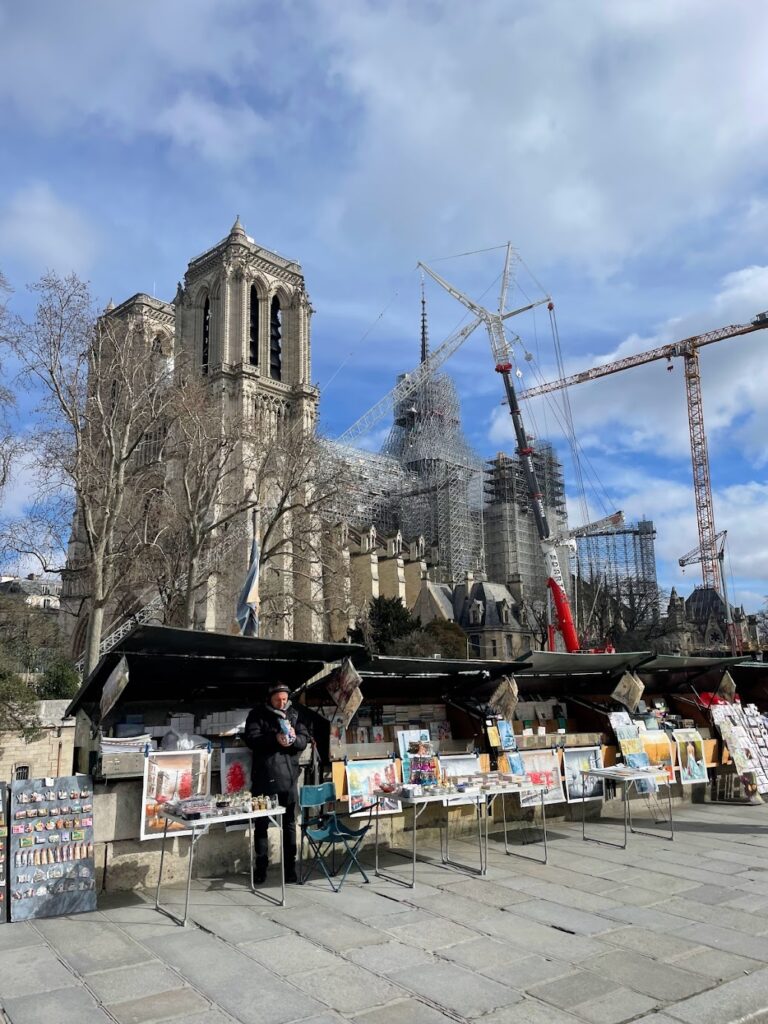
While the spire now stands proud against the Parisian skyline, at ground level, there’s been a buzz of a different sort. The bouquinistes, those iconic riverside booksellers whose green stalls have lined the Seine for centuries, were at the heart of a heated debate. There was talk of temporarily relocating them during the Olympics for security reasons, which sparked outcry from locals and literature lovers globally.
Become a Notre-Dame de Paris expert online
Did you know ? the cathedral of Notre-Dame has its own MOOC. It’s fascinating, and it’s in English.
You can subscribe here to the Notre-Dame’s MOOC , on the website of the Fondation Orange. Or watch it in Youtube, if you do not feel like a student
If you do not feel like studying, then maybe you could read the absolutely fascinating Victor Hugo’s novel Notre-Dame de Paris ?(set apart a few dozen hours… It is a very rich and long novel, but one of the best texts about medieval, pre-Haussmanian Paris).
And if you want to test your language skills, why not try it in french ?
The bouquinistes : saved by the President
In a city that prides itself on both cultural heritage and modernity, the proposal faced staunch opposition. President Emmanuel Macron finally stepped into the fray, making a decision that resonated with many: the bouquinistes would stay. This resolution underlines a commitment to Paris’s historical fabric, even amidst the whirlwind of an international sporting event.
The controversy highlighted the balancing act between preserving tradition and accommodating a global event like the Olympics. Macron’s decision to keep the bouquinistes in place is not just a win for the small-scale vendors but a statement that Paris’s charm lies in its blend of the old and the new, the monumental and the everyday.
As Notre-Dame’s reconstruction progresses, it stands as a testament to the city’s ability to renew and persevere. The cathedral, much like the bouquinistes, is an integral part of Paris’s identity—both are set to continue their legacy as the city gears up for a celebration of global unity and athletic excellence next summer.
This photograph captures more than a moment; it encapsulates the seamless integration of beauty into daily life for Parisians. For us, the grandeur of Notre-Dame and the charming bouquiniste stalls aren’t mere tourist attractions; they’re waypoints on our commutes, backdrops to our daily routines, and the familiar sights we navigate by.
Every single bit of Paris offers us a daily reminder that we live in a city steeped in history, yet vigorously forging ahead. As a local, the beauty of this city is a constant, interwoven into the very rhythm of our daily lives, not just a spectacle for visitors. No wonder that the banks of the Seine are a Unesco World Heritage site. And no wonder that Chat GPT mentioned it as one of the 237 reasons to fall in love with Paris
The Olympic Games will come and go, but the story of Paris—the blend of the everyday with the exceptional—will continue. It’s in the quiet resilience of the bouquinistes and the determined restoration of an architectural icon where the true spirit of Paris lives on.
The Bouquinistes of Paris: Guardians of Written Treasures
Welcome to the scenic banks of the Seine, where history is not just in the monuments, but also in the green-painted boxes that line the river’s edge. Here, the bouquinistes of Paris offer literary gems and cultural artefacts to locals and wanderers alike.
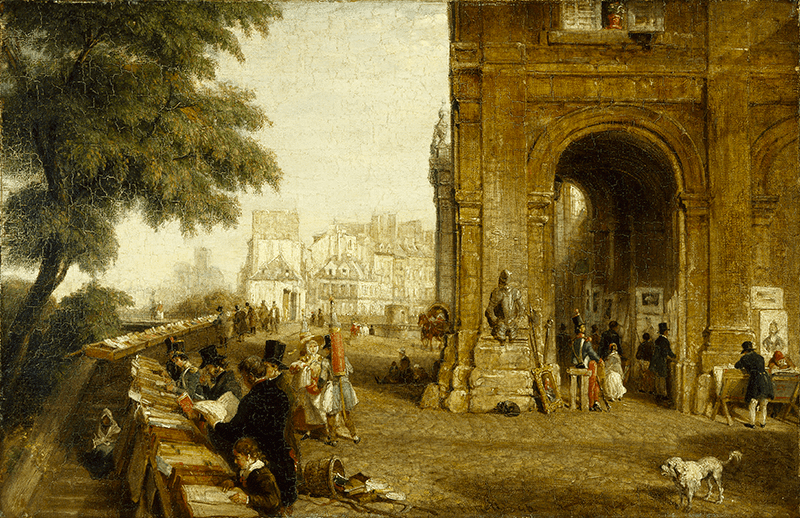
Carnavalet Museum, History of Paris
Originating from the term ‘bouquin,’ a word that harkens back to 1459 and possibly derived from the Flemish ‘boeckijn’ for ‘small book’, these vendors have become as iconic as the city’s landmarks. The first official mention of a ‘bouquiniste’ was in the 1762 edition of the Dictionnaire de l’Académie française, defining them as sellers and buyers of ‘old books, or Bouquins.’
This tradition started in the 16th century with itinerant peddlers. Facing opposition from the booksellers’ guild, a 1649 regulation banned portable stalls and displaying books on the Pont Neuf. However, the bouquinistes persevered, enduring periods of expulsion and reacceptance.
With the beautification of the quays under Napoleon I, the bouquinistes spread from Quai Voltaire to Pont Saint-Michel, finally gaining recognition and a status akin to public merchants of Paris.
In 1859, the city of Paris formalized their presence with fixed concessions. Each bouquiniste was entitled to 10 meters of parapet for an annual fee. The boxes, now a hallmark of the bouquinistes, were standardized in size by 1930.
Today, over 200 bouquinistes manage close to 900 boxes along the Seine, from the Pont Marie on the Right Bank to the Quai de la Tournelle on the Left Bank. These boxes unfold to reveal a treasure trove of around 300,000 books, along with prints, magazines, and vintage postcards.
In 2019, the bouquinistes of Paris were recognized as part of the intangible cultural heritage of France, cementing their place not only in Paris’s history but also in its living culture. At the same time, the authorities started fighting against the growing tendency of some bouquinistes to become tourist souvenirs resellers (against the law)
As you stroll along the quays, don’t hesitate to have a look, some boxes are worth the detour.






[…] see many things just walking by : Notre Dame, the Louvre, The bouquinistes (See the article about Notre Dame and the Bouquinistes), The French Academy, the Musée d’Orsay, the Musée du Quai Branly, the Grand Palais, the […]