French Etiquette, from salutations to the café ritual : get rid of that anxiety

Table of contents
[show]
Welcome to a journey through the nuances of French etiquette, as seen through the eyes of a Parisianist…
Many of my international friends are intrigued by what they perceive as a maze of unspoken rules unique to the French way of life. While it’s flattering to think of our customs as exquisitely complex, the truth is, Parisians are quite welcoming and forgiving towards newcomers.
The mystique surrounding French etiquette might seem daunting, but most Parisians are more than willing to help you navigate these social intricacies. So, in response to the frequent queries about fitting in, I’ve compiled some essential tips to ease your integration into the vibrant and diverse tapestry of Parisian society.
Let’s explore these keys to understanding and embracing the elegant, sometimes enigmatic world of Parisian etiquette.
The Art of Greetings
- Navigating the nuances of ‘la bise,’ the quintessential Parisian cheek-kiss, can seem like a dance shrouded in mystery. But fear not, it’s simpler than it appears. Here’s the lowdown:
- The Technique: It’s all about the cheek graze rather than an actual kiss. Lean in right, and let the graceful air-kiss commence.
- The Great Kiss Count Conundrum: Paris typically plays it cool with two kisses, one on each cheek. However, venture beyond the city limits, and you might find yourself in a three, or even four-kiss territory! The catch in Paris? You’re never quite sure where the person you’re greeting hails from. My advice? Start with two, and after that second kiss, pause and read the situation. Is a third kiss in the cards? It’s a subtle dance of intuition and reaction.
- Even for a seasoned Parisian like myself, the exact number of kisses remains a delightful enigma. So, embrace the uncertainty and remember, a misstep in the bise ballet is no faux pas.
- Handshakes: When the situation calls for something more formal, a handshake is your go-to. It’s a simple art : it should be firm, confident, yet respectful. It’s the hallmark of professionalism and is best reserved for first encounters or formal settings.
- In the world of Parisian greetings, whether it’s the light brush of cheeks or the firm clasp of hands, each gesture carries its own language and charm. Embrace these customs with an open heart, and watch as the city embraces you back.
Dress to Impress
In the city of haute couture, Parisian fashion is often seen as the epitome of chic, understated elegance. The cliché suggests a wardrobe of neutral tones, well-tailored fits, and just a hint of a signature accessory – a nod to the adage that less is more in the fashion capital.
The Reality of Parisian Style
Here’s the real scoop – Paris is a melting pot of styles, influenced by diverse communities, social strata, subcultures, and professional vibes. As you meander through the city’s streets, you’ll witness a kaleidoscope of fashion choices, from the meticulously tailored to the effortlessly casual.
Sure, there’s a small faction that might raise an eyebrow at your sartorial choices, but hey, you can either shrug it off with Parisian nonchalance or opt for a simple, clean, and versatile wardrobe that sails smoothly through any occasion.
A Note on Religious Symbols
Touching on a sensitive topic – religious symbols. As a secular nation, France’s religious landscape is quite subdued, contrasting sharply with its deeply religious history. In Paris, you can express your faith discreetly without any fuss. However, more overt religious displays might raise eyebrows or, in some cases, lead to discomfort.
It’s an unfortunate truth that not all religious symbols are perceived equally in the streets of Paris. A small Christian cross might pass unnoticed, while Islamic symbols tend to draw more attention. Though most Parisians are indifferent, life has its way of bringing you face-to-face with the few who might take notice. This aspect of French society, admittedly, isn’t its most commendable feature.
In conclusion, Paris’s fashion scene is as diverse as its people. Whether you’re embracing the city’s chic stereotype or expressing your individual style, remember: in Paris, your fashion is your statement, and the city is your runway.
Café Culture
The Legendary ‘Garçon de Café’ of Paris
First, let’s not forget the legendary ‘garçon de café’ – the quintessential Parisian waiter. These are no ordinary waiters; they are as much a part of the café’s fabric as the aroma of freshly brewed coffee. They move with a balletic grace and efficiency, masters of their domain, embodying an air of professional detachment mixed with just the right dash of Parisian flair.
The ‘garçon de café’ is an iconic figure, so much so that Jean-Paul Sartre, the famed philosopher, used him as an example in his existential writings. For Sartre, the garçon embodied ‘bad faith’ – a person overly absorbed in their role, almost to the point of becoming a caricature. This observation is a testament to the garçon’s ingrained presence in the cultural and philosophical landscape of Paris.
While the modern café scene might have evolved, the garçon remains a symbol of the traditional Parisian café culture. So, before you sit down for your petit café, look at the personal, and try to guess if you are in the right place. take a moment to appreciate these unsung artists of the Parisian streets. Their brisk walk, sharp eye, and perhaps a subtly raised eyebrow are all part of the unique tapestry that makes Paris, Paris.
How to spot a café with real “garçons de café” ?
If you are after the authentic “garçon de café” experience, you’ll need a guide. Here are some tips to spot such a café:
- Observe the Waitstaff’s Attire: The classic ‘garçon de café’ is typically dressed in a smart uniform, often a white shirt, black trousers, a waistcoat, and sometimes a bow tie or apron. The attire reflects a blend of formality and efficiency.
- Check for an Old-School Ambiance: Cafés that have been around for decades and retain a sense of historical charm are more likely to employ traditional garçons. These places often exude a sense of history and have a loyal local clientele.
- Look for Classic Café Aesthetics: The more traditional Parisian cafés often have a timeless look with outdoor seating, bistro chairs, and marble-topped tables. They usually feature quintessential Parisian décor like Art Nouveau accents, mirrored walls, and polished brass. More modern cafés can very well
- Location Matters: Explore well-known historical areas like Saint-Germain-des-Prés, Le Marais, around Montmartre, or around the main train stations. These neighborhoods are rich in history and are more likely to have cafés that uphold traditional practices.
- Watch the Service Style: Traditional garçons are known for their professionalism, efficiency, and sometimes, a no-nonsense attitude. They manage busy terraces with skill and are adept at balancing multiple orders simultaneously.
- Look for Patrons Engaged in Traditional Activities: Cafés where you see people lingering over their coffees, reading newspapers, or engaged in animated conversation, rather than hurriedly grabbing a coffee to go, are more likely to offer the traditional garçon experience.
Remember, visiting a café with traditional ‘garçons de café’ isn’t just about the drink or the food; it’s about immersing yourself in the Parisian experience.
I have many favourite cafés in all the areas of Paris. Les Cadrans, in front of Gare de Lyon, Père et Fils, rue Montmartre, or Le Père Tranquille, in front of the Forum des Halles, are examples of perfectly traditional cafés where I often spend hours reading or writing.

Jean-Paul Sartre’s Garçon de café
“Consider this café waiter. His gestures are quick and emphatic, a bit too precise, a bit too rapid, he approaches the customers with a step a little too brisk, he bends over with a bit too much eagerness, his voice, his eyes express an interest a little too solicitous for the customer’s order (…). He is playing, he amuses himself. But what is he playing at? One need not watch him long to realize: he is playing at being a café waiter.” Why does he play? Because he is afraid of truly realizing himself.
Jean-Paul Sartre ‘Being and Nothingness’ (1943).
The café ritual and its variations
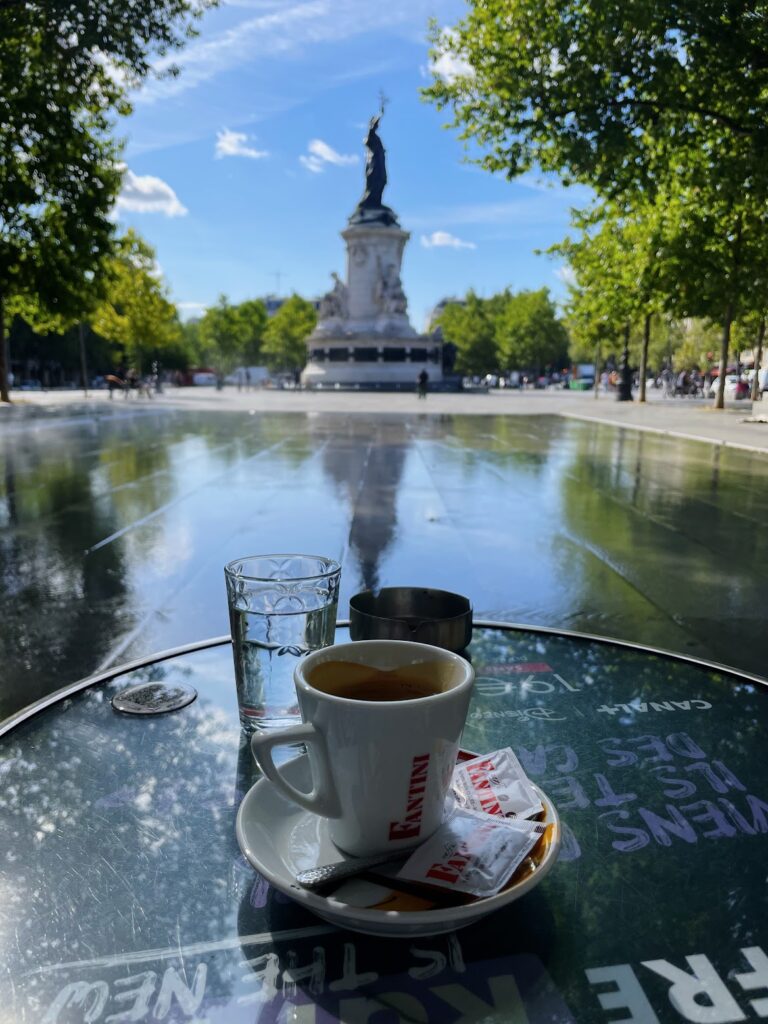
- Savor, Don’t Rush: At Parisian cafés, time slows down. Coffee is to be savored, not gulped. Find a cozy spot, order un petit café, and watch the world go by.
- Tradition vs modernity: As a world city, Paris is a place where you can find all sorts of sophisticated cafés, lattes and other varieties. But the real café, the “petit noir”, is the one you should try at least one. If you don’t like it strong, order an “allongé” instead. It is the same café, with more water, and therefore less bitterness. Just say “Un allongé s’il vous plaît“, and the waiter will know what you asked for.
- In a rush ? Have your café at the bar. The “Savor, Don’t Rush” rule is not always true : cafés are also the place where you might need to stop a few minutes, for a phone call, for a small wait between two meetings. If your time is limited, then stay at the counter. You’ll be served faster and can pay immediately, then disapper.
- Tipping: Service is included in the bill, but leaving a few coins is a polite gesture for good service. With the generalization of credit cards, this rule is less pregnant. And cafés have sometimes hard time to find
- Paying with a credit card : the french law allows merchants to impose a minimum amount for accepting credit card payments. It is quite frequent in cafés (but not only).
In summary, it is a good practice to always carry a few Euros for a drink, a sandwich or shopping of small items.
Dining Decorum
- Bread Etiquette: Your delicious baguette goes directly on the table, not on a plate. And resist the urge to butter it at dinner.
- Mealtime is Sacred: In Paris, meals are a ritual, an experience compared to other countries. They are a time for conversation. Even at work between colleagues. So : be ready to take your time, engage in lively conversation, and enjoy every bite.
Navigating the Metro
For those who discover parisianism.com through this article, the topic is treated in detail in this article : Mastering the Metro: Your Guide to Public Transportation in Paris.
The most important advice (also found in the linked article) : Parisian metros are not the place for loud conversations or phone calls. Embrace the silence, and remember, personal space is a prized possession, even in a crowded carriage.
Shopping with Courtesy
- Bonjour and Merci: The magic words in any Parisian place, including shops. Greet the staff as you enter, and always say ‘thank you’ as you leave.
I’ve often heard that parisians are rude. It is not my experience. If you show consideration to people with a “Bonjour” and a smile, you’ll be treated kindly. Really : politeness opens doors in Paris (and not only in Paris, actually, according to my experience).
Mastering the Language
- Attempt the Accent: Even if your French is not parfait, making an effort is appreciated. Start with the basics – Bonjour, Merci, Parlez-vous anglais ? (Hello, thanks, do you speak english ?).
- Using English : In lots of place, people will understand basic english and answer your questions. But do not expect everybody to be able to have a conversation with you, specially among older people. The french education system has never been expert in teaching tongues.
The Over-enthusiasm ‘Faux Pas’
- In Paris (in most parts of France, actually), subtlety is key. Overly animated gestures or high volumes in conversation can seem out of place. Embrace the art of being understated.
- This also applies to human relations : being too enthusiastic in salutations, smiling too much, are not usual and can appear artificial, specially with people you don’t know well. Be kind and open, smile, but stay natural.
What about the Culture ?
- Art, Literature, and History: many strangers have the sensation that they will be rejected if they cannot display indications of a high cultural level. Actually, people who show interest in French culture are always appreciated, and cultural knowledge is always respected. But don’t overdo it (remember the previous paragraph about over-enthusiasm ?). And remember that lots of french people are not specially interested in culture, too. Like in many countries.
Conclusion: Be Open, Be Observant
Integrating into Parisian life is like a dance. Watch, learn, and soon you’ll be moving in rhythm with the city. Embrace the nuances of French etiquette, and before you know it, you’ll not just be in Paris – you’ll be a part of it.
That’s it. French etiquette is not so complicated, and remember : most french people are tolerant and helpful, as long as you stay natural and open.