Mastering the Metro: Your Guide to Public Transportation in Paris

Embark on a delightful escapade through the Paris Metro! Dive deeper into its history, navigate its twists and turns with ease, and discover its hidden quirks in our extended guide.
Bonjour, future Metro maestros ! Get ready to unravel the mysteries of Paris’s beloved underground. Think of this as your all-access, backstage pass to the city’s heartbeat – the Metro. Fasten your seatbelts (or, well, stand comfortably) as we take a deep dive into the labyrinth of Parisian transit.
A Stroll Down Memory Lane: The Metro’s Humble Beginnings
Picture this: the year is 1900, the world is in the throes of the Belle Époque, and
Paris decides to join the metro Revolution already started in London, Glasgow, Budapest and Chicago… (Last chance to enter the top 5 !).
Paris is always ahead of the curve when it came to big ideas, but can be slow to act upon them. Case in point: a whole century before the Metro became a reality, there were already lively debates about revolutionizing the city’s transit system. These discussions gave birth to the charmingly named “Petite Ceinture” (literally, “Small Belt”) in 1845 – a surface railway line elegantly encircling Paris (still in use today, recently modernized as a beautiful tramway line). But as for the Metro, well, it was tapping its foot impatiently, waiting for the politicians to stop their chin-wagging and make a decision!
Thinking about it, it is very strange that Baron Haussman, the man who transformed Paris between 1853 and 1870, didn’t add the Metro to his legacy.
Still, in the whirlwind year of 1900, Paris wasn’t just twiddling its thumbs – oh no! The city was buzzing with the grandeur of hosting both a World’s Fair and the Olympic Games, a series of global festivities that put the ‘extra’ in ‘extraordinary’ for the City of Lights !
This double dose of expected Universal Prestige was the element of motivation that made it possible to take the step : enter the Paris Metro, marvel of the time, initially spanning from Porte de Vincennes to Porte Maillot, just for the inauguration of the World’s Fair, and oh boy, did it steal the show !
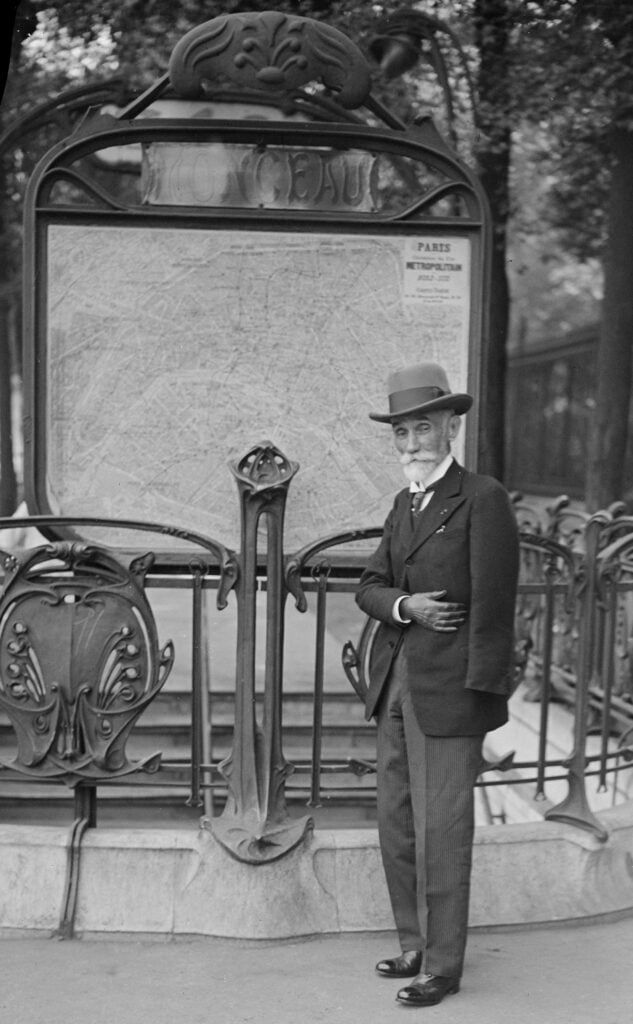
On the photo, he stands in front of a characteristic Art Deco station, in the style created by Hector Guimard.
A few “Guimard” stations still subsist around Paris. Among them :
Palais Royal musée du Louvre – Place du Palais Royal, rue de Rivoli
Châtelet – rue de Rivoli, rue des Lavandières Sainte Opportune
Étienne-Marcel – 14 rue de turbigo
Louvre Rivoli – rue de Rivoli
Tuileries– rue de Rivoli
Quatre septembre – rue du Quatre septembre et rue de Choiseul
Réaumur Sébastopol; Cité, Temple, Saint-Michel, Cadet, Opéra, Château d’Eau, Colonel Fabien, Gare du Nord
And that was just the beginning… The rest, as they say, is history – a long, winding tale we’ll tuck away for another day. Now, let’s fast-forward to the present and dive into the bustling, modern world of the 2024 Parisian Metro, where history meets the high-speed hustle of today’s City of Lights!
In the fast-paced world of 2024, the pulse of Paris’s transportation – the Metro and its trusty fleet of buses – is kept beating by none other than the mighty RATP, short for Régie Autonome des Transports Parisiens (Independent Parisian Transportation Authority), steering the city’s commuters through the streets and tunnels of Paris.
The Paris Metro, like a fine wine, has only gotten better with age. It’s stretched its wings far and wide, now boasting 16 lines that weave through the city and around, connecting an impressive 309 stations. And to navigate it, you’ll need a plan…
Decoding the Map: The Art of Navigation
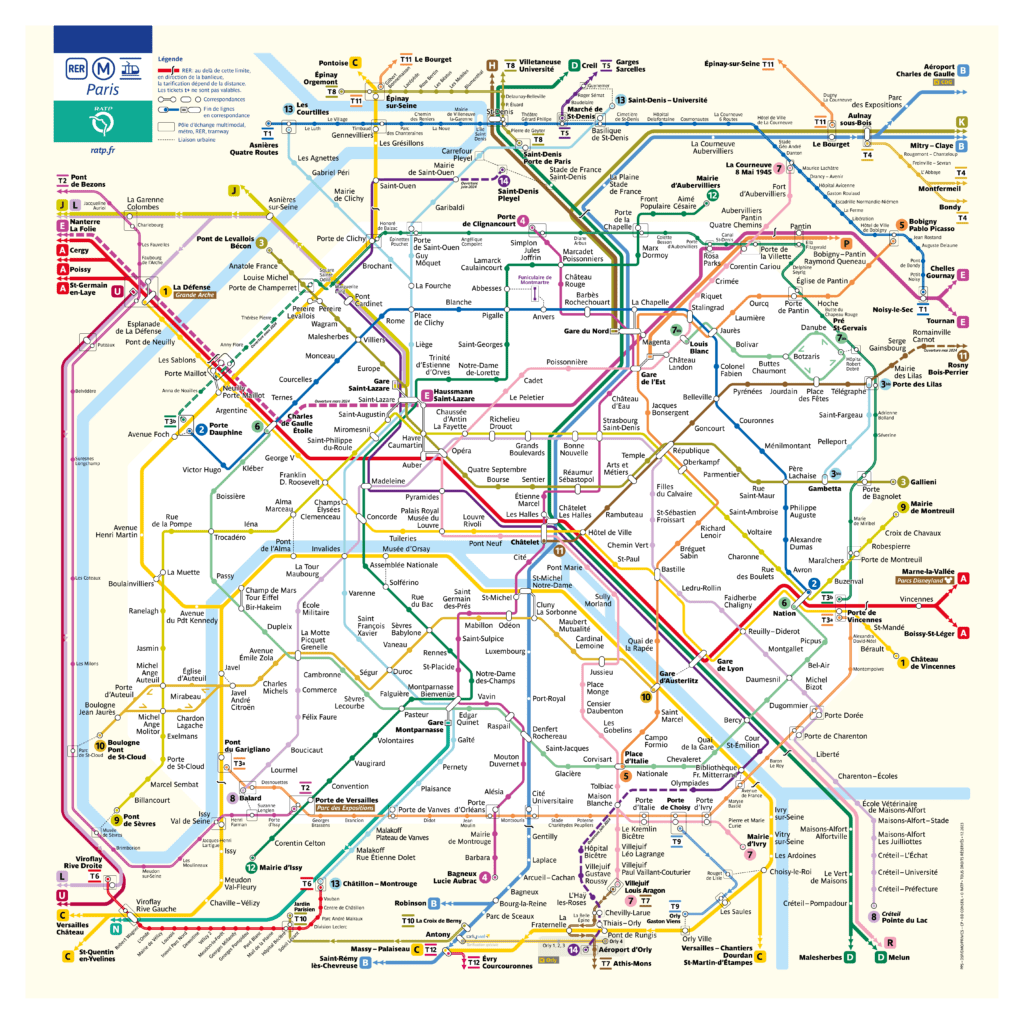
See or download the map : https://www.ratp.fr/plan-metro
Navigating the Paris Metro is like solving a delightful puzzle. Each line is color-coded. Thankfully, because who can remember numbers, right ? (Actually, as a daltonian, I have to stretch myself a little to stay on your side about this color thing, but I’ll be happy if it can help you).
Each direction is named after the last stop of the line. Pro tip: Keep an eye out for the whimsical station names – some are straight out of a storybook. Each station could have its own detailed post on this website, full of stories, memories and events and images… I’ll think about it, but let’s get to the point.
Here are a few pieces of advices and things to know to survive the beginner test of Underground Paris.
- Tickets and Passes: Options abound ! From single-use tickets to the weekly ‘Navigo’ pass or electronic/mobile options, choose your arsenal. And remember, losing a ticket is like losing a piece of your soul down here.
All the information about tickets and formulas, on the RATP website - The Lines: Each line has its own personality. Line 1, the old-timer, takes you through historical landmarks. Line 2 offers panoramic views of Montmartre, and Line 14, the speedy Gonzales of the Metro, is a modern marvel, etc…
- The stations : Dive into the enchanting world of Paris’s Metro stations, where each stop tells its own captivating tale (OK. I’ll write more about that…).
– Take Châtelet-Les Halles, for instance – it’s not just any station; it holds the title of the largest underground transport hub in the world !
– Then there’s the intriguing mystery of Paris’s “phantom stations” like Arsenal, Porte Molitor, and Haxo – echoes of the past, no longer bustling with commuters but brimming with stories.
– Some, like the “Cluny-la Sorbonne” station, play a game of hide and seek, disappearing in 1939 only to reappear in 1988.
– Delve deeper, and you’ll find Abbesses, challenging the fittest with its 176 steps leading you 36 meters below the surface.
– And let’s not forget Cité, a unique gem nestled underwater, or Place des Fêtes, doubling as an aerial defense shelter back in the day.
– And for a quiet escape, Église d’Auteuil awaits, with the smallest footfall, whispering tales of a bygone era. I have a special sweet spot for this one, since my beloved Grandmother lived just here…
Each station is a chapter in Paris’s grand Metro narrative, waiting to be explored ! Just stay curious, and you’ll hear all these stories.
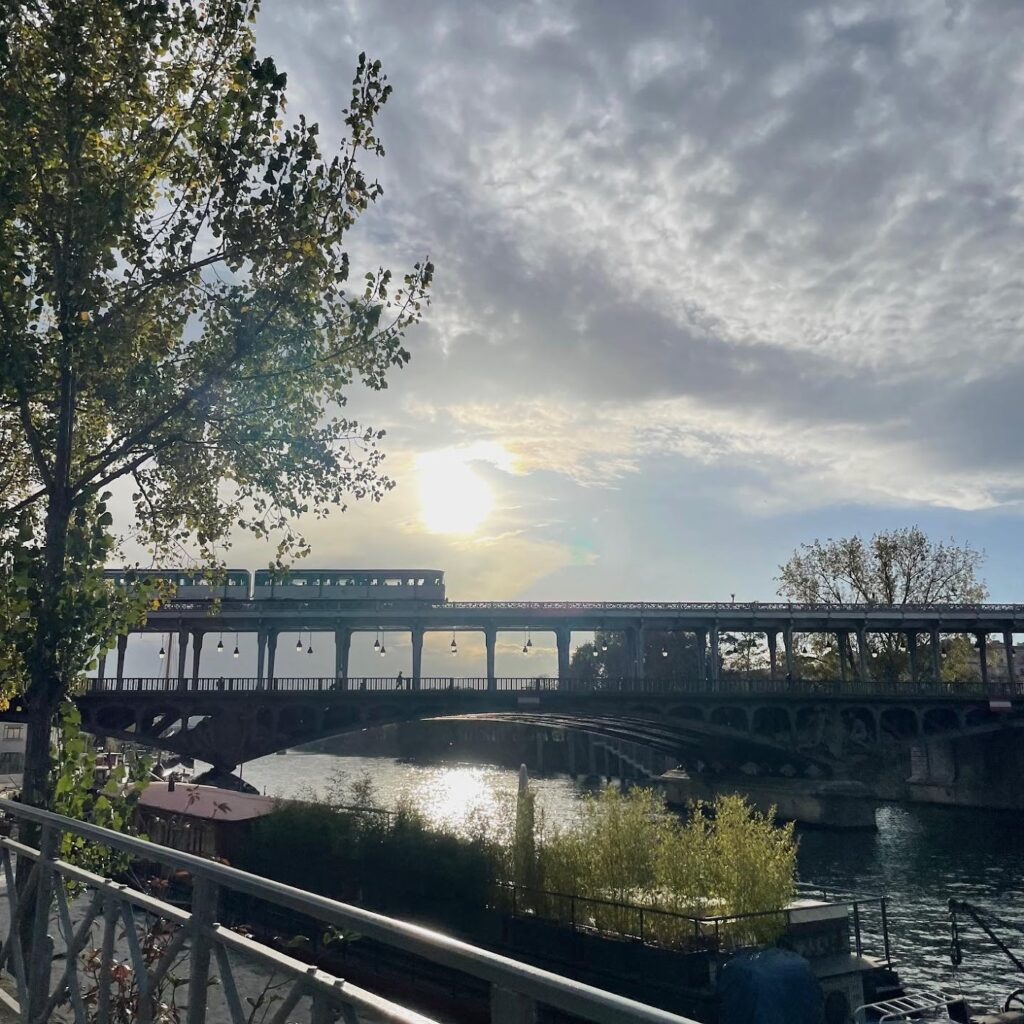
The aerial lines are a beautiful way to admire the city.
Etiquette and Oddities: The Unwritten Metro Code
The Metro has its own set of unspoken rules. It’s like joining a secret society, but less ominous. Basic introduction for beginners :
- Escalator Etiquette: Standing on the right and walking on the left isn’t just polite; it’s survival.
- The Doors: They don’t open automatically at every station, except on the automatic lines. Look for the magical button or lever.
- Rush Hour Revelries: Experience the Metro at rush hour, and you’ll understand the true meaning of ‘packed like sardines.’
- Entering/exiting: when hopping on or off, stand aside, not in front of the subway doors. Let folks stream out through the middle, then glide in from the side or center if it’s clear. Remember, blocking the door is a tourist faux pas, especially during the mad dash of rush hour. Be savvy, and keep the Parisian commute smooth!
- Strapontin rules : In the heart of Paris’s subway cars, you’ll find ‘strapontins’ – those quirky folding seats near the doors. If the car’s bustling with people, keep these seats folded up. Watch and learn from the locals, who’ll gracefully stand up from these seats as more passengers come aboard. It’s all about space and courtesy in the bustling world of Parisian transit!
- Don’t be loud : On the Paris Metro, the person speaking loud or chatting on their phone is probably not a local. Parisians usually embrace a quieter ride, so keep it down. You’ll enjoy it in the end!
- Backpack Etiquette: In a crowded car, swing your backpack off, even if it’s a small one. It prevents the dance of awkward bumps and shuffles – much appreciated by everyone.
- Seat Kindness: In Paris, it’s common courtesy to offer your seat to the elderly or pregnant passengers – even the city’s toughest kids do it. Join the tradition of kindness!
- Pardon is the Word: Navigating through a packed car? A gentle ‘pardon‘ as you squeeze by is the Parisian way of keeping things polite and smooth.
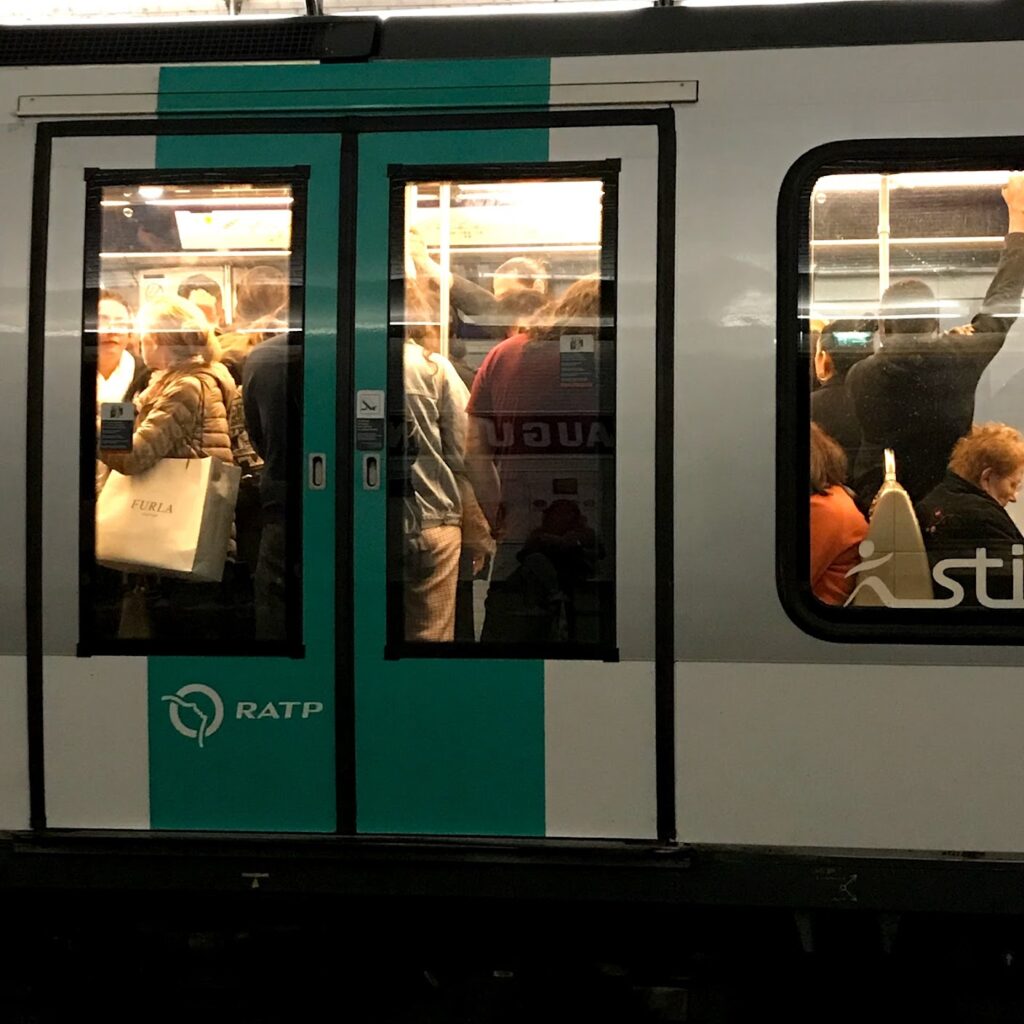
Conclusion: Your Metro Mastery Badge
Congratulations! You’re now equipped to conquer the Paris Metro with the flair of a local and the curiosity of a savvy traveler. Whether you’re commuting, sightseeing, or just enjoying the ride, the Metro is your gateway to the many faces of Paris.