André Breton, the Surrealism in person and Paris as its experimental field (1896–1966)
Explore André Breton’s journey through Paris, from rue Fontaine to the lost Passage de l’Opéra — where real and imaginary places shaped surrealism.

Table of Contents
Poet, theorist, agitator — André Breton moved through Paris like a magnetic field. Surrealism, of which he was the founder and guardian, was not merely a literary school: it was a way of looking at the city, of projecting dream and desire onto its walls. From rue Fontaine to the covered arcades, Paris was his laboratory of thought.
A Feverish Youth
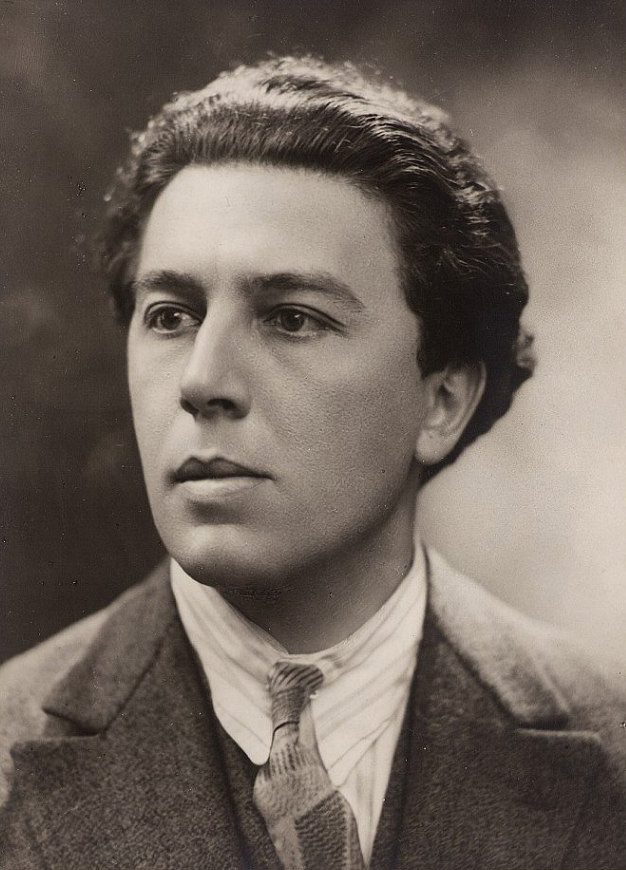
Born in Tinchebray in 1896, Breton grew up in Pantin, just outside Paris. He developed an early interest in medicine and psychiatry. During the First World War, assigned to the Val-de-Grâce military hospital, he witnessed mental alienation and met Jacques Vaché, who became a model of radical detachment.
“I demand freedom of the mind for tomorrow.”
— Letter to Jacques Vaché
Paris, Dreamscape of Exploration
Upon returning from the war, Breton settled in Paris. In the early 1920s, he became the figurehead of a burgeoning movement: surrealism. Around him gathered Aragon, Soupault, Desnos, Ernst, Man Ray…
The city became their playground: dérives, poetic interrogations, explorations of forgotten places.
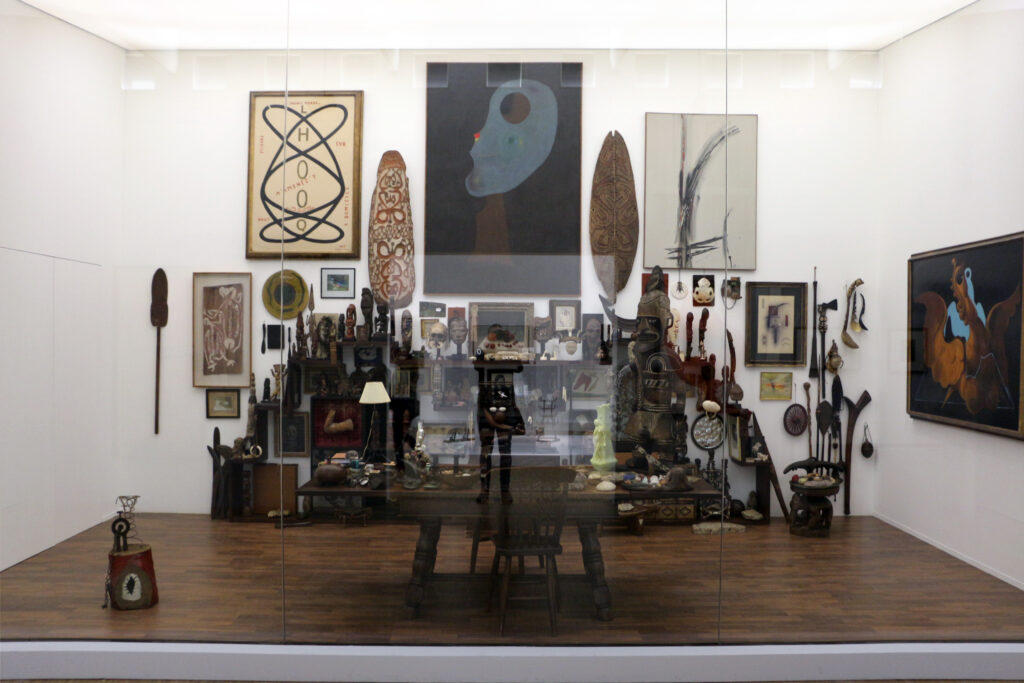
Breton lived at 42 rue Fontaine (9th arrondissement), in an apartment-studio that remained his sanctuary for over forty years. There, he collected paintings, objects, masks, fetishes, and documents. His desk — spectacular and cluttered with fascinating objects — has been preserved and reinstalled identically at the Centre Pompidou.
The reconstituted office is currently closed to the public (Pompidou reopening planned for 2029).
Nadja: Wandering, Fascination, Vanishing
Published in 1928, Nadja is a first-person prose-poem, a journal of wandering through a dreamlike Paris. It features cafés, theatres, shop windows, statues, plaques, glances.
“I go towards what happens to me.”
— Nadja
The Paris of Nadja is not documentary — it is a city of apparitions and cryptic messages, where each detail might deliver a poetic jolt.
One Hundred Years of Surrealism
In September 1924, Breton published the Surrealist Manifesto, the founding act of a literary, artistic and philosophical movement.
“Surrealism, n. m. Pure psychic automatism…”
— Surrealist Manifesto
In September 2024, the text turns 100 years old. A chance to rediscover its influence on modern creation… and on how we see Paris.
Resistance and Renewal
During the war, Breton went into exile in New York, continuing his pursuit of total poetry. Upon returning, he spent part of each year in Saint-Cirq-Lapopie, but always came back to rue Fontaine, his creative and spiritual refuge.
What Remains of Him
The surrealist movement experienced fractures, polemics, and exclusions. But Breton’s magnetic gaze remains. He overlaid Paris with a poetic grid that anyone can still activate.
His flat has vanished — but his spirit still lingers:
- in the galleries of the Marais
- in the covered arcades
- in the absurd objects of antique shops
Following in Breton’s Footsteps
42 rue Fontaine (9th) – Apartment-Studio
Breton’s home and creative space, now reconstructed at the Pompidou Centre.
✨ The reconstituted office is currently closed for renovations (reopening 2029).
Passage Jouffroy, Passage Verdeau, Passage Choiseul
Referenced in Nadja as sites of vision, unease and enchantment.
“I enter this deserted passage, and time thickens…”
Place Dauphine
Key location in Nadja, where the titular character seems to dissolve into the unseen.
Café Certa (now gone), bd Montmartre
First meeting point of the surrealist group in 1921.
Rue de l’Odéon (6th)
Frequented by the avant-garde, near Shakespeare & Co.
Saint-Cirq-Lapopie (outside Paris)
Breton’s late-life retreat, which he called “the most beautiful village in the world.”
Fictional Places in His Works
Passage de l’Opéra (destroyed)
Central site in Nadja. Breton transforms it into a place of apparition and vertigo.
“The figures mingle with the glass. The Opéra is in ruins. I pass through with the feeling everything will shatter.”
Imaginary Street of the Equinox (L’Amour fou)
A dreamed street — metaphor of love and chance.
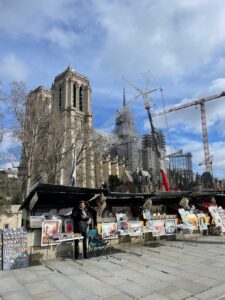
Found objects along the quays
A mental landscape where poetry emerges spontaneously.
A vanished theatre between two unnamed streets
An oneiric metaphor for the collective unconscious.
Related Figures
| Name | Role | Link with Breton |
|---|---|---|
| Jacques Vaché | Founding influence | Inspired surrealist tone |
| Philippe Soupault | Co-founder of the movement | Co-wrote Les Champs magnétiques |
| Louis Aragon | Comrade then rival | Political and artistic rupture |
| Nadja (Léona C.) | Real woman and spectral figure | Symbol of objective chance |
| Marcel Duchamp | Associated artist | Parallel experimenter |
Further Reading
- André Breton – Complete Works (Pléiade)
- Nadja (Folio)
- André Breton, Convulsive Beauty – Henri Béhar
- France Culture Podcast